
All Creation Testifies
On the Architecture & Philosophy of the POGO Studios Archive
The created world is not silent; it is perpetually witnessing.
Everything made is a witness to a maker. Creation does not just exist; it is perpetual, sourced, and it speaks. Creation implies an audience, a creator, a record, and a truth. Every creation is simultaneously evidence of its creator and a declaration of what it means to be created at all.
Historically, art has always been created with more care than it has been documented. This is not meant as an accusation — it is just the honest nature of making.
The act of creation yearns for full presence. Creation preservation demands systematic consistency, and a long view that most artists, collectors, and institutions are unable to maintain. This results in a gap that quietly widens over time and presents real challenges after a work leaves a studio.
Core Challenges for Artists, Collectors, and Institutions
For the Artist - ephemerality of context.
Works accumulate. Memory fades. Platforms disappear. The story behind a work gradually detaches from the work itself, until all that remains is an object with no verified origin and no one left to speak for it. When authenticity is questioned, most artists have nothing more than their word — and their word requires their continued presence to carry weight.
For the Collector- trust without verification.
A collection is built on relationships — with the artist, the gallery, the certificate sitting in a drawer. But those relationships are fragile. Artists become uninvolved or unavailable. Galleries close. Paper gets lost, damaged, or disputed. When the time comes to resell, donate, or pass a work to an estate, the provenance chain is often thinner than anyone realized. The question "Can you prove this is real?" has no good answer for most collected works.
For the estate or heir - interpretation without the interpreter.
When an artist's active presence ends, someone else inherits responsibility for the catalog — and usually inherits chaos. Unidentified works, conflicting records, and no clear accounting of what exists. Establishing value, authenticating, and honoring the artist's intentions becomes an expensive and often impossible undertaking. Most estates lose significant value simply because the documentation was never there.
For the archivist or institution - standardization and the source of truth.
Independent artists rarely produce documentation that meets institutional standards. There is no consistent format, no independent verification layer, and no way to confirm records against any external data. An institution either accepts documentation at face value, rejects it, or spends limited valuable resources trying to verify it through other means — thus limiting the potential for relationships to form between independent artists and institutions.
For the art world broadly - forgery and provenance fraud scale invisibly.
Certificates of authenticity are among the most forged documents in the global art market. The traditional system has no cryptographic layer — it relies entirely on social trust, which degrades over time and fails silently. As works change hands more frequently and markets expand, the gap between what is claimed and what can be verified grows wider with every transaction.
This archive exists as a direct answer to that gap.
1. The Artist as Archivist
This system was not outsourced to a registry, delegated to a platform, or built by a third party. It was designed, structured, and is actively maintained by the artist. That choice carries meaning. It suggests that the archive reflects the same standards of intention and care applied to the work itself. It means no intermediary controls access, interpretation, or continuity; and the system can evolve in response to the work itself, instead of reacting to an outside entity’s roadmap, capabilities, or business decisions.
2. Legible by Design
Cryptographic systems are often only legible to the people who built them. This archive was designed with the opposite priority. Records are stored as plain JSON files with clear field names, consistent structure, and no proprietary formatting. The format was chosen deliberately: plain JSON is both human-readable and machine-parsable, satisfying two kinds of legibility at once without requiring a translation layer between them. Human & Machine Legibility is treated as a feature, not an afterthought. So a collector with no technical background, an estate attorney encountering the archive for the first time, a curator researching the work decades from now — any of them can open any record and understand it from any place, any time.
3. A Unified Language
Every POGO artwork — regardless of medium — is assigned an ID within a unified naming structure. Most works carry no traditional title. This is intentional. A title is an interpretation — it directs the viewer before they've had the chance to understand on their own. The ID identifies without explaining: it establishes existence, authorship, and sequence, then steps back. What the work means is left entirely to the encounter between the piece and the person in front of it. This isn't just organizational convenience — it is a declaration that medium doesn't determine a work's place in the catalog, and neither does a name. The ID system is the common language of the entire studio, and its silence on meaning is an essential part of the point.
4. Separation of Presentation and Truth
In a world where physical and digital existence increasingly coincide, an artwork or its image travels. It appears across feeds, on platforms that were never prepared for permanence. Enabling the presentation of a work to multiply in ways its maker never intended or controls.
This archive maintains a deliberate separation between where a work appears and what a work is. Providing a verification layer, apart from any display context. This means a work's visual presentation can change, move, be updated, disappear, or appear across multiple platforms without ever affecting the integrity of its original record. What the archive holds is not the image — it is the truth behind the image.
5. Seal as Living Lineage
The POGO Studios seal is not a logo. It is a verification constant — a single mark that appears intentionally layered across the art, archive, and studio as a whole. It is stamped directly onto the back of each physical work and printed on its corresponding certificate. It also exists in digital origin as a parent inscription on the Bitcoin Blockchain — a permanent digital anchor from which every archival year structurally descends.
These are not redundant appearances. Each instance of the seal exists in a different context, serving a different verification function, and together they form an unbroken thread that runs from the object itself through its documentation and into the permanent record. No single instance can be altered without breaking correspondence with the others.
6. The Provenance Triangle
Every Archived POGO artwork is verified across three independent layers:
A physical layer encompassing the work itself, the archival stamp, and a paired certificate.
A digital layer including the GitHub & Website Archive, gallery, and storefront.
A cryptographic layer that anchors image hashes and record indexes permanently on Bitcoin.
These three layers are synchronized at the moment of documentation and mutually reinforcing from that point forward. None can be altered independently without breaking correspondence with the others. Three independent lines of verification converge to confirm the same truth. Authenticity is not claimed in one place. It is continually confirmed across three.
7. A Timestamp Cannot Lie
Every traditional system of authentication shares one fundamental vulnerability — it requires someone to believe someone else. A signature requires trust in the signer. An institutional record requires trust in the institution. A witness account requires trust in the witness. All of these are social agreements, and social agreements degrade. People become unavailable. Institutions close. Memory fails. The further a work travels from the moment of its creation, the thinner the thread of social trust holding its authentication together becomes.
Cryptographic proof operates on entirely different terms. It does not ask for belief. It does not require the continued presence or credibility of any person or institution to remain valid. A cryptographic timestamp is a mathematical fact — immutable, public, and independent of every human variable that traditional authentication depends on. It cannot be backdated, forged, denied, disputed, or destroyed by social means. This archive is built on that foundation, not as a technical novelty, but as a direct response to the known fragility of every system that came before it.
8. Each Year is Closed, Not Abandoned
The principle of cryptographic permanence is enacted in this archive through a specific and deliberate practice: the formal close of each archive year. At the conclusion of every creation year, the complete index of documented works is cryptographically anchored on Bitcoin — a single, permanent, timestamped commitment that marks the boundary between active documentation and settled record. This is not a technical formality. It is the moment a living archive becomes a historical fact. The works documented within that year are now part of a closed, immutable chapter — independently verifiable by anyone, at any point in time, without access to the artist or the archive's current infrastructure. Each year builds on the last, descending from the same root seal, creating a chain of closed chapters that grows more complete and more permanent with every passing year. The archive is always open going forward. It is always sealed behind.
9. The Record Outlasts the Platform
Most platforms that have ever hosted creative work have also, eventually, shifted, shrunk, or outright disappeared. This is not pessimism — it is the general story of digital and creative infrastructure. This archive is built on optimizing decentralized systems — An Official Studio Website and GitHub for public accessibility, plus Bitcoin for cryptographic proof and permanence — an architecture that no single actor owns, controls, or can sunset.
The record does not survive because someone chose to maintain it. It survives because no single actor has the ability to end it. And because the archive's permanence is independent of where the work appears, the surface layer is free — new platforms explored, new mediums tried, new tools experimented with, without any of that risk touching what has already been recorded. The foundation is fixed. Everything made on top of it is free to move and grow.
10. The Collector's Guarantee
Collecting a work of art has always required a degree of trust in the artist — that they'll remember the work, that their records are accurate, that they're reachable if questions arise years later. This archive removes that dependency entirely. Any collector, at any point in time, can independently locate a work's record, confirm its creation, review its history, and verify its place in the archive without contacting the artist or any third parties. The guarantee is an act of personal, technical, and structural preparation - work done early, so the collector never has to wonder.
11. Built to Grow
The POGO Studios Archive was rebuilt in 2025 into its current canonical form — and works documented under the prior system were migrated forward rather than left behind. That decision reflects a core principle: the archive grows without abandoning what already exists. What is recorded today will not become irrelevant tomorrow. The structure was designed with deliberate openness — leaving room for embedded certificates, expanded metadata fields, new media types, image permanence solutions not yet fully resolved, and documentation practices that haven't even been invented yet. The archive accommodates the future without destabilizing the past. It is a system designed to remain current not by replacing itself, but by expanding around what is already there and preparing for what can be.
12. Built to Last
Each artwork eventually outlives its artist, and each archive eventually outlives its archivist. This system was built with that assumption from the start. Most artist documentation systems are legible only to the person who created them — organized around personal memory, private shorthand, and contextual knowledge that exists nowhere but in the artist's mind. When that context and connections to it are gone, the records lose coherence, and the work loses value. This archive was built for the people who may encounter it without any of that context — heirs and estates navigating a catalog they didn't create, institutions considering acquisition decades from now, collectors verifying works long after the original transaction.
The structure is self-explanatory. The records are complete. The cryptographic anchors require no authority to validate. There is something quietly intentional about building a system designed to function without you — it is an acknowledgment that the work matters beyond the lifetime of the person who made it, and a commitment to honoring that by doing the preparation now. The archive does not depend on memory, testimony, or the continued presence of its creator. It was built to speak for itself, perhaps forever.
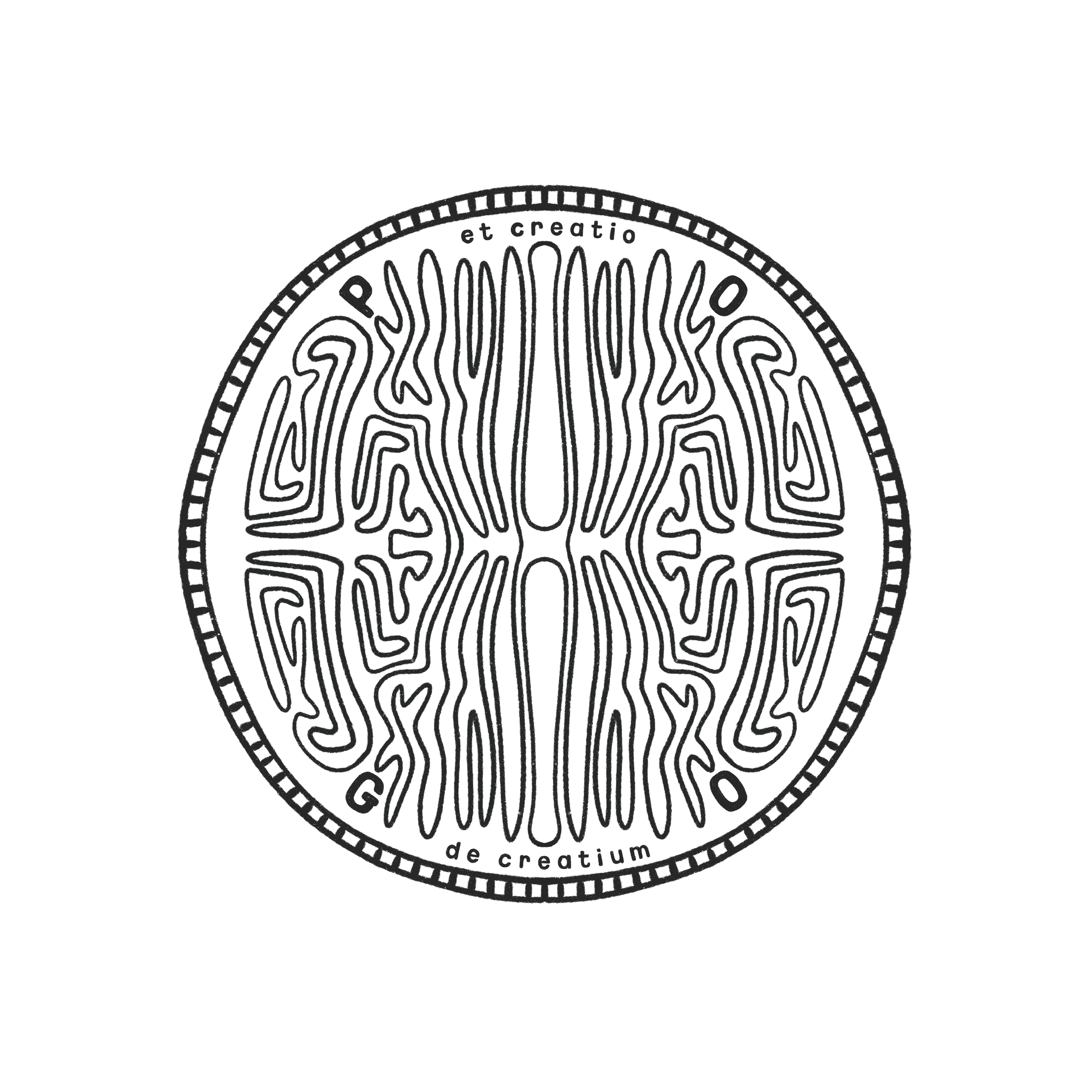
Et Creatio, De Creatium
“and creation, from creation”
These words appear on the POGO Studios seal — stamped onto every physical work, present on every paired certificate, inscribed permanently on Bitcoin, and structurally present as the root from which every archived year descends. These words are not decoration. They are a cosmology.
A phrase crafted for this purpose — Latin in structure, ancient in concept. The idea they carry is not new. Across traditions, centuries, and cultures, makers and thinkers have arrived independently at the same recognition: that nothing is made from nothing, and nothing made disappears without a trace. Creation inherits and bequeaths simultaneously. What came before lives in what exists now. What exists now will live in what comes next.
This archive was built inside that understanding. If every made thing carries the mark of what preceded it and passes something forward to what follows, then documentation is not an administrative burden — it is a form of honoring that chain. Each work descends from the seal. Each year descends from the last. Each cryptographic anchor becomes part of a permanent ledger that no single actor controls and no passage of time can erase. The archive does not merely record creation. It participates in it.
There is something in the act of building a system designed to outlast yourself — to speak clearly to people you will never meet, about work made in moments they weren't present for — that reflects the same truth the phrase has always carried. You are not the origin. You are not the end. You are one point in a line that was moving before you arrived and will continue long after the last record is written.
All creation testifies. This archive ensures the testimony endures.
For full technical documentation, record architecture specifications, and the complete archive index, visit the POGO Studios Archive - READ.me - on GitHub.